
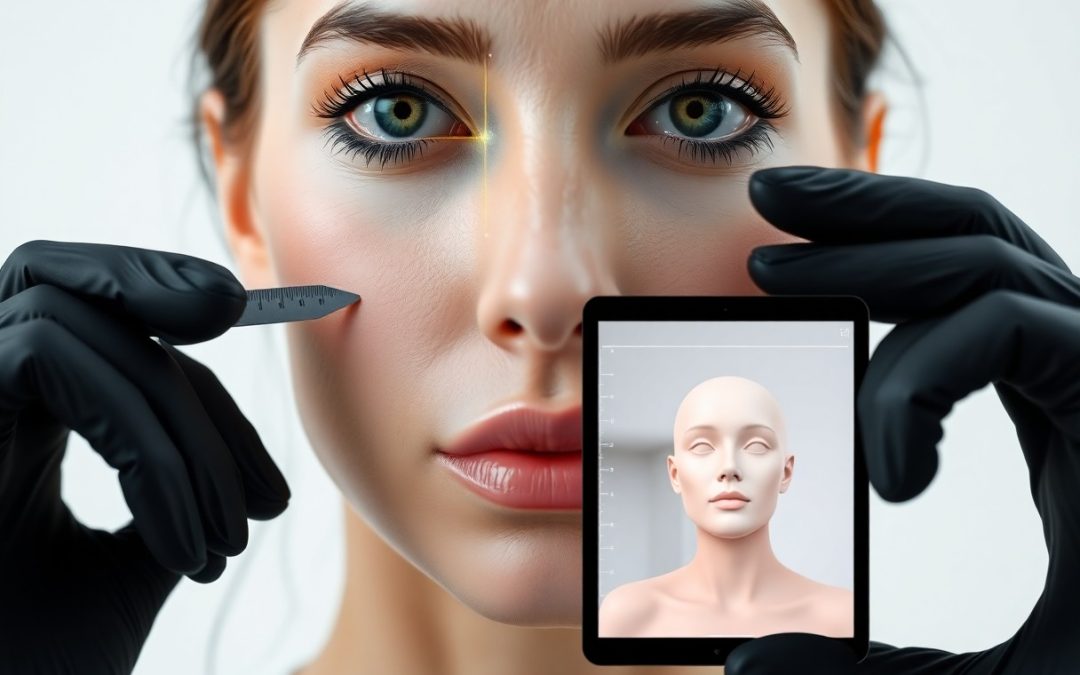
Just as symmetry and balance define facial harmony, your unique proportions shape the choices you make in cosmetic enhancement. Your features guide which procedures align with natural aesthetics, ensuring results complement your individual structure. Understanding these proportions helps you achieve subtle, personalized improvements that enhance your appearance with precision and authenticity.
The Divine Geometry of Vanity
You’ve always been drawn to faces that seem perfectly balanced, though you may not know why. Hidden patterns govern what we find beautiful, rooted in mathematical precision rather than random preference. These proportions shape how you perceive attractiveness and influence your choices in cosmetic enhancement.
Mathematical Symmetry in Human Features
Your face reflects a quiet order beneath its surface. Symmetry plays a silent role in how others interpret your expressions and judge your appeal. Studies show that even slight deviations from balance can shift perception, guiding your decisions when considering aesthetic refinement.
The Allure of the Golden Ratio
Your perception of beauty may be shaped by a number: 1.618. This ratio appears in nature, art, and the most admired faces, creating harmony between facial segments. When your features align closely with this proportion, they tend to draw more positive attention.
Beauty isn’t purely subjective-your brain responds to specific spatial relationships. The Golden Ratio, often seen in the distance between eyes, nose, and chin, creates a sense of natural balance. When facial elements reflect this proportion, they appear more harmonious, subtly influencing your desire for refinement that mirrors these timeless patterns.
The Tyranny of the Vertical Third
Facial symmetry often hinges on the balance between the upper, middle, and lower thirds of your face. When one segment dominates, it disrupts harmony, drawing attention away from your natural features. You may find yourself seeking adjustments not for vanity, but to restore proportion and ease visual tension others may perceive instantly.
Balancing the Brow against the Chin
Your brow and chin form the frame of your face, anchoring its vertical structure. If one extends too far beyond the other, the silhouette loses equilibrium. A recessive chin can make the forehead appear larger, while a prominent brow may overshadow a shorter lower face. Adjusting either can recalibrate your profile’s balance.
Measuring the Midface for Aesthetic Grace
Your midface length-measured from the base of your nose to the brow-plays a subtle yet defining role in facial harmony. When this segment aligns with the upper and lower thirds, your features appear naturally balanced. Disproportion here can shift perception, making eyes seem too close to the mouth or forehead too dominant.
When assessing your midface, practitioners often use the vertical third rule as a guide, comparing the distance from glabella to subnasale with the other facial segments. If your midface is shorter, it may create a compressed appearance, sometimes prompting subtle volumizing or structural refinement. A longer midface might suggest a need for chin projection to maintain balance. Your unique proportions guide these decisions, ensuring changes enhance rather than alter your identity.
The Surgeon’s Needle and the Sculptor’s Eye
Beauty emerges not from uniformity but from thoughtful refinement. You seek not to erase your features but to refine them, guided by an artist’s precision and a physician’s knowledge. Every adjustment considers proportion, shadow, and expression-transforming subtle imbalances into natural harmony without sacrificing authenticity.
Harmonizing Individual Traits with Idealized Norms
Balance defines attractiveness, yet ideals vary across cultures and eras. You navigate this space by aligning your unique structure with proportions shown to convey symmetry and health, while preserving the qualities that make your face distinctly yours. The goal isn’t replication-it’s enhancement rooted in individual truth.
Correcting Asymmetry without Erasing Character
Most faces deviate slightly from perfect symmetry, and those quirks often lend charm. You allow minor imbalances to remain when they contribute to your expression, while addressing only those discrepancies that disrupt overall harmony. The aim is refinement, not uniformity.
Asymmetry is rarely a flaw-it’s often a signature of natural growth and lived experience. When you correct it, the focus stays on subtle recalibration: softening a heavier side, lifting a drooping contour, or balancing volume. These micro-adjustments enhance cohesion without flattening the personality your face conveys. Your history lives in these nuances, and skilled intervention honors that truth.
The Heavy Burden of a Singular Nose
One feature often dominates facial perception more than any other-your nose. Its central placement means even subtle imbalances draw attention, altering how your entire face is read. Many seek refinement not for vanity, but to restore harmony when nasal prominence overshadows other traits you wish to express.
Impact of Nasal Prominence on Facial Equilibrium
Your nose acts as the face’s visual anchor. When it projects too far or carries disproportionate width, it disrupts the flow between forehead, eyes, and chin. This imbalance can make other features appear recessed or less defined, shifting the perception of your overall symmetry and balance.
Chin Projection and the Perception of Strength
Your chin’s forward presence influences how strong or defined your jaw appears. A recessed chin may unintentionally soften your profile, creating an imbalance that draws focus away from your eyes or cheekbones. Subtle enhancement can restore proportion and sharpen facial definition.
Chin projection plays a quiet but powerful role in shaping first impressions. When your chin aligns properly with your forehead and nose, it completes the lower face with structural confidence. You’re not chasing an idealized look-you’re aligning your features so none compete, allowing your natural expression to come through clearly and cohesively.
The Inevitable Decay of Structural Grace
Time quietly erodes the balanced architecture of your face, altering the proportions that once defined your youthful appearance. As bone resorbs and soft tissues descend, the harmony you once had shifts subtly, then noticeably. These changes are not flaws-they’re natural, predictable transformations that influence how you consider aesthetic refinement.
Volume Loss and the Shifting Midface
Volume diminishes most dramatically in your cheeks, creating a hollowed appearance that ages your expression. As fat pads migrate downward, the midface flattens, blurring the distinction between upper and lower thirds. This descent alters shadow patterns, making eyes appear sunken and cheekbones less defined, directly impacting facial balance.
Restoring Youth through Proportional Realignment
Reintroducing volume in strategic zones rebalances your facial thirds and lifts descending tissues. By targeting the cheeks, temples, and jawline with precision, subtle enhancements can reverse the visual effects of aging. Your natural structure guides where correction delivers the most authentic, harmonious results.
Proportional realignment isn’t about adding volume indiscriminately-it’s about restoring what time has displaced. Injectables and implants work best when placed according to your original skeletal blueprint, not trends. When your midface volume is re-established along aesthetic vectors, light reflects as it once did, softening shadows and redefining contours without altering your identity. The goal is not perfection, but familiarity-the version of you that still looks unmistakably like you, just refreshed.
The Paradox of Universal Beauty
Beauty claims to be universal, yet its standards shift across cultures and centuries. You recognize certain facial proportions as pleasing, but those ideals are shaped more by context than biology. What appears harmonious in one society may seem unremarkable in another, revealing that symmetry and balance are interpreted through cultural lenses, not absolute rules.
Global Perspectives on Facial Beauty
Preferences in facial structure vary widely from region to region. You might admire high cheekbones in Paris, while full cheeks signify health and prosperity in parts of West Africa. These differences reflect deeper values-youth, fertility, strength-shaping what each culture celebrates as beautiful.
Navigating Diverse Definitions of Perfection
Standards of facial perfection differ as much as the people who hold them. You encounter conflicting ideals whether consulting global trends or personal heritage. This diversity challenges the notion of a single ideal, urging a more inclusive understanding of aesthetic choices.
Perceptions of facial perfection are rarely static. You may seek symmetry, yet asymmetry defines character in other traditions. Some cultures prize a strong jawline, while others favor softness and roundness. Your cosmetic decisions, then, become a dialogue between personal desire and cultural context, shaped by influences you may not even recognize.
Summing up
With these considerations, your facial proportions directly shape the choices you make in cosmetic enhancement. Symmetry, balance, and alignment guide both subtle refinements and more defined changes. Understanding how your features relate to one another allows for decisions that enhance natural structure while maintaining harmony and individuality.