
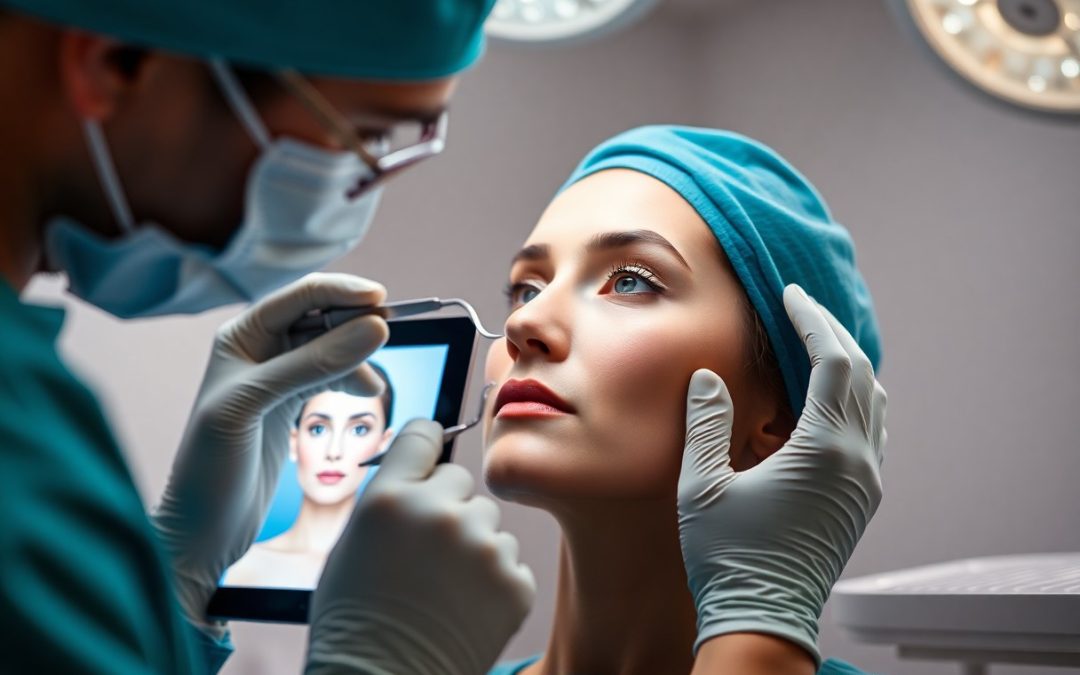
It’s your face that benefits from a cosmetic surgeon focused on facial balance and symmetry; you receive precise assessments, customized procedures, and measured outcomes that enhance proportion while preserving natural expression.
The Philosophy of Facial Harmony
In practice you consider bone structure, soft-tissue balance, and facial motion to refine proportions so results enhance your natural identity rather than copy an ideal.
Defining the Golden Ratio in Modern Aesthetics
When you reference the Golden Ratio, you use mathematical landmarks to guide nasal, orbital, and lip relationships without enforcing a single aesthetic.
The Science of Symmetry and Perceived Attractiveness
Studies show that when you perceive symmetrical faces, your brain processes them more fluently, which often increases perceived attractiveness and trustworthiness.
Neuroscience shows you respond to bilateral symmetry via reward circuits, yet you also value subtle asymmetries that convey individuality; surgical planning balances these factors to produce natural, personalized outcomes.
Structural Procedures for Midface Balance
Midface structural procedures help you restore harmonious proportions by repositioning bone and adding targeted volume to cheeks and the maxilla, improving projection and symmetry for a balanced facial profile.
Precision Rhinoplasty as an Anchor for Proportion
Precision rhinoplasty refines your nasal framework to serve as an anchor for midface proportion, adjusting dorsum, tip, and base so the nose complements cheek projection and orbital relationships.
Malar Augmentation and Cheek Symmetry
Malar augmentation restores cheek fullness and lateral projection so you achieve improved facial thirds and smoother transitions between the infraorbital rim and nasolabial fold.
Techniques for malar augmentation range from tailored implants to microfat grafting and hyaluronic acid placement, chosen based on your anatomy and longevity goals. Surgical implants provide predictable projection and can be contoured to correct asymmetry, while fat grafting offers soft tissue refinement with regenerative benefits. Precise vectoring, subperiosteal placement, and staged follow-up help maintain natural, lasting cheek symmetry.
Defining the Lower Facial Profile
You evaluate the lower facial profile by examining mandibular contour, chin projection, vertical height, and soft-tissue drape to ensure symmetry and proportion with the midface and neck, guiding targeted surgical planning for balance and function.
Mandibular Contouring and Jawline Alignment
Precision sculpting of the mandible lets you refine jaw angle and contour, correct asymmetry, and improve facial length using osteoplasty, implants, or adjunctive soft-tissue techniques tailored to your anatomy.
Chin Genioplasty for Vertical and Horizontal Balance
Chin genioplasty reshapes projection and vertical height so you achieve harmonious facial thirds, proper occlusal relationships, and improved chin-to-neck contour through advancement, setback, or vertical modulation.
Surgical planning uses cephalometric analysis and 3D imaging so you can choose sliding genioplasty for controlled bone repositioning or an implant for predictable projection, with soft-tissue tailoring, nerve-sparing technique, and clear recovery expectations aligned to your goals.
Rejuvenating the Periorbital Region
You can restore brightness and symmetry around the eyes by addressing skin laxity, fat pad descent, and hollowing, improving facial balance with targeted periorbital procedures tailored to your anatomy and goals.
Correcting Eyelid Disparity through Blepharoplasty
Blepharoplasty refines asymmetrical lids by removing excess skin and repositioning fat, so you achieve matched eyelid heights and natural crease symmetry while preserving function and a refreshed appearance.
Brow Lift Techniques for Equalized Positioning
Brow lifts adjust forehead contours to correct unequal brow height, allowing you to harmonize orbital relationships with endoscopic, temporal, or direct approaches chosen for minimal scarring and durable, symmetrical results.
Endoscopic approaches permit precise eyebrow repositioning with small incisions, enabling you to correct lateral or central asymmetry while adjusting muscular suspension; open and temporal lifts offer direct shaping when greater elevation or skin excision is needed.
Non-Surgical Refinement and Volumization
Non-surgical refinement uses targeted fillers and neuromodulators to correct asymmetry and restore harmonious contours, allowing you to achieve balanced facial proportions without surgery.
Strategic Dermal Filler Placement for Soft Tissue Correction
Targeted filler placement restores lost volume, supports soft tissues, and refines contours so you can correct asymmetry and maintain natural facial proportions with conservative, measured injections.
Neuromodulators for Balancing Dynamic Expressions
Neuromodulators reduce hyperactive muscle pull to balance movement-driven asymmetry, allowing you to soften dynamic lines while preserving natural expression and facial animation.
You will undergo muscle mapping and tailored dosing to soften asymmetrical contractions; results emerge in days, peak by two weeks, and can be adjusted at follow-up to fine-tune balance while preserving voluntary expression.
Summing up
As a reminder, you should choose a cosmetic surgeon who prioritizes facial balance and symmetry, understands aesthetic proportions, uses evidence-based techniques, and tailors plans to your anatomy to achieve natural-looking results while minimizing risk.